
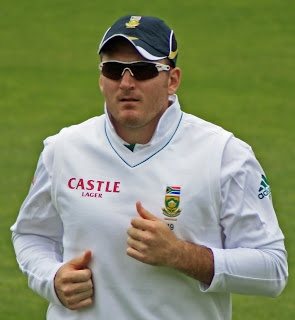

South Africa is one of the greatest cricketing nations in the world. With over 130 years of Test cricket, the number of quality players South Africa has produced is both impressive and immense. But who would be, objectively speaking, the greatest playing XI in South African cricket history? To avoid the risk of bias and/or jealousy we’ve used the highest rated players in the history of SA cricket to create a dream XI. So without further ado, let’s get cracking.
At opener we have Graeme Smith. Smith was rated the #76 highest Test batsman of all time. He reached a career high rating of 843 points. His highest ranking was #2, he achieved both these rankings on the 18th of January 2010 against England. Smith scored 9265 runs in 117 Tests at an average of 48.25. He scored 9028 runs at an average of 49.07. As a lovely bonus, Smith would be captain, meaning we don’t have to find a way to squeeze a captain in.
Partnering Smith is Herschelle Gibbs, who has the eighty second highest batting rating of all time. He peaked at #6 in the rankings. Gibbs scored 6167 runs at an average of 41.95. His highest Ranking position was number six. His best rating was 825, which he achieved in January 2004 after scoring 192 vs the West Indies.
This was a debatable position as Gary Kirsten actually had a higher all time ranking than Kirsten, having peaked at number 4, but his peak rating was nearly 60 points less than Gibbs’, so Gibbs wins by virtue of having had a higher rankings total.
At number three we have Hashim Amla. Amla, the “Silent Warrior” has the 31st highest ranking of all time, with a peak rating of 907 points. He peaked at #1 all time. Amla scored 9282 Test runs in 124 Tests, at an average of 46.6. At his peak, he scored 1229 runs in 10 Tests at an average of 81.93 to get to his peak rating.

At number four we have Graeme Pollock. Pollock scored 2256 runs at an average of 60.97. He peaked at #1 with a peak rating of 927, which is good for the 17th best rating of all time. The great Pollock achieved his highest rating following scores of 52 and 87 in February 1970. He scored 274 against Australia the Test before that, which was good for, at the time, the highest ever score by a South African cricketer.
At number five we have the GOAT himself. Inarguably the greatest cricketer in the history of cricket. Jacques Kallis. Kallis is the first of many all-rounders to make the list. Kallis scored 13289 Test runs at an average of 55.37. He also took 292 wickets at an average of 32.65. Those numbers are enough for him to be the #1 run-scorer in South Africa’s Test cricket history, he also has the sixth most wickets in South African cricket history
Kallis peaked at 615 all-rounder points, which are enough for the third greatest peak all-rounder rating of all time. He peaked at 742 ICC points as a bowler, and was once rated as the sixth best bowler in the world. He peaked at 935 points as a batsman, which is the 13th greatest peak rating of all time. During that peak point he scored 767 runs and five hundreds in four games at an average of 127.83. At some point in 2002 Kallis was in the top 10 of both the bowling and batting rankings. He is the single greatest cricketer we’ve ever produced. By some distance.
At number six, we have Dudley Nourse. A name most here would not know, but Nourse scored 2960 runs at an average of 53.81 with nine centuries. He achieved a peak rating of #1 with 922 points after he scored 208 runs against England. Nourse was arguably the first real batsman of any quality in South African cricket history. He was best bat on an incredibly poor team. South Africa won two Test matches in 34 Test that he played in, but he was, the unquestioned best batsman in the world
Coming in at number seven we have AB de Villiers. De Villiers scored 8765 runs at an average of 50.66 He peaked at #1 in the ICC rankings with 935, which is good for the 13th greatest Test rating of all time. He scored 116 runs against Australia in February of 2014. So this is the first real debate. AB only kept in 24 Tests, whereas Mark Boucher kept in 147 and Quinton de Kock in 50 but he did score 2067 runs runs and seven centuries at the position, so logically, if Graeme Pollock played enough games to make the list, the AB de Villiers did too.
At #8, as the first bowling all-rounder we have Shaun Pollock. Pollock took 421 test wickets at an average of 23.11, and scored 3781 runs at an average of 32.31 with two centuries. Pollock peaked at #1 in the bowling rankings with a peak rating of 909 points, which is good for the 12th greatest bowling rating of time. He achieved this rating in 1999 when he took twin four fers against England in his 36th Test. He peaked at #1 in the all-rounder rankings in September 2003.
At #9 we have Vernon Philander. If we use only batting or bowling peak, Philander might be the single greatest cricketer in South African cricket history. Philander had the most explosive start to Test cricket for a century as he took 50 wickets in his first seven Tests at an average of 14! For his career, Philander took 224 wickets at an average of 22.32 and scored 1779 runs at an average of 24.04. He peaked at 912 ranking points, which was good enough for number one in the world at the time and is the seventh highest rating of all time. Not a single South African has placed higher ever.
At #10 we have the incomparable Dale Steyn. Steyn held the position of #1 in the ICC rankings for an unmatched, and quite frankly unfathomable 2343 days. He picked up 439 wickets at an average of 22.95. His peak ICC rating of 909 was enough for him to be crowned #1 in the world, and is the 12th highest rating of all time. He achieved his highest ranking following a 6/34 against the West Indies.
At #11 we have the hardest decision in the team. Kagiso Rabada with a peak rating of 902 is the next highest on the list. His peak rating is good for 22nd all time. That said though, Hugh Tayfield is a spinner, and with a peak of 895 points, he’s only slightly behind Rabada, while adding balance to the team as a spinning option. Ultimately, this is a fantasy team, meaning we can ignore things like balance in favour of fire power. And also, this is supposed to be purely about the higher ICC rating, so KG wins by virtue of having peaked slightly higher. Rabada achieved his peak in March 2018 against Australia having taken an 11 wicket haul in a Test match which was famous for… other reason. And a series which was famous for other other reasons. To date Rabada has taken 308 Test wickets at an average of 21.67. He is the only active player on this list.


Leave a Reply