
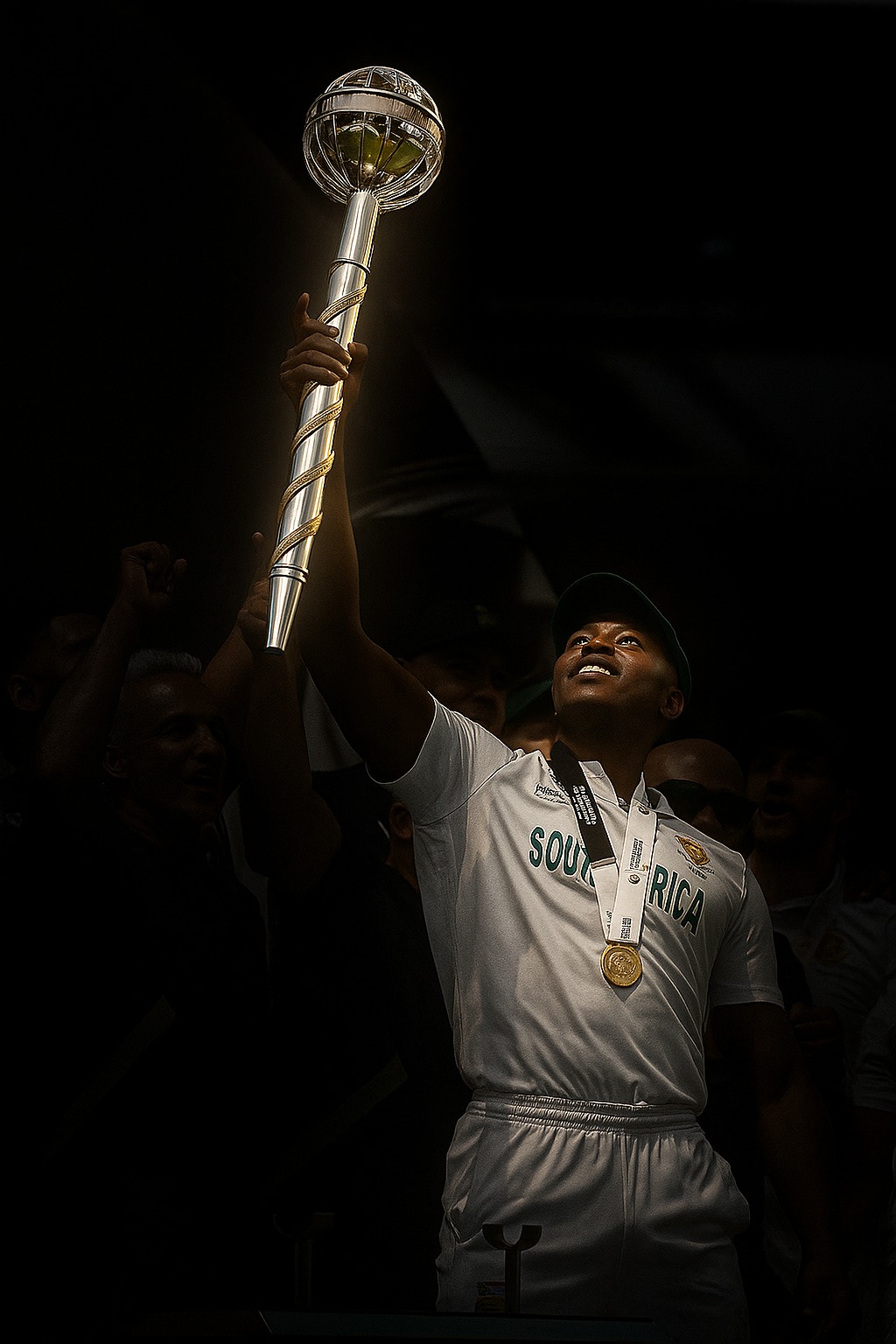
There are moments in sport when time seems to slow down—not because the action is suspended, but because the consequences of it echo forward. For Kagiso Rabada, that moment came at Lord’s in the World Test Championship final. It was not just a fine performance—it was an arrival. Not the sort that follows a maiden five-for or a breakthrough tour, but the rarer kind: the one that turns a great cricketer into a permanent fixture in a nation’s imagination.
We’ve long known what Rabada was capable of. From the time he took 13 wickets in a Test against England as a 20-year-old, he’s been earmarked as one of the three geniuses of his generation—alongside Pat Cummins and Jasprit Bumrah. The raw pace. The seam movement. The shape in the air. The ability to bowl spells that change matches. But brilliance alone is never enough. Cricket is a game of timing—of when, as much as how. Rabada had done everything except deliver the kind of moment that history can’t ignore. Until now.
It’s fitting that it came at Lord’s, the ground that insists on history. It’s not just a venue—it’s a verdict. You don’t play well at Lord’s; you etch your name. In the space of two summers, Rabada has now taken consecutive five-fors there—first against England, now in a World Test Championship final against Australia. But this wasn’t just about numbers. This was about temperament. It was about clarity. It was about a player whose entire career has simmered on the edge of greatness finally stepping into it without flinching.
South Africa’s path to victory was anything but straightforward. A first-innings lead squandered. A second innings deficit that ballooned beyond 280. An opposition that had the trophy in sight. In those moments, the gap between potential and performance can swallow careers whole. It didn’t. Because when Rabada got the ball on that third evening, he made the moment his own.
Three quick wickets upfront to open up Australia’s top order, and a constant presence even as Ngidi stole the headlines with a spell that finally delivered on his rich promise. Rabada wasn’t just effective—he was authoritative. It wasn’t the express pace of his early years, or the raw hostility of a tearaway. It was something calmer. More exact. More permanent.
“I don’t see myself as a star,” Rabada said after the match, in a tone that almost made you believe him. “I see myself as someone who’s willing to give my blood for this team.” There’s always been a humility in how Rabada sees himself, even as the numbers suggested otherwise. Now, the accolades are starting to match the effort.
It would be easy to reduce this to a single performance, but it’s really the culmination of a decade spent toeing the line between expectation and execution. Rabada entered the national setup as a teenager and instantly became both symbol and solution. A black fast bowler with charisma and brains. A ready-made face of the “next” South Africa. With each new era—post-AB, post-Philander, post-de Kock—Rabada remained. Carrying, always, more than just the ball.
Through it all, he’s worn the responsibility without ever appearing burdened. His interviews are typically measured, reflective, even a little dry. But his bowling tells you everything you need to know. When the pressure rises, Rabada doesn’t inflate. He compresses. His action gets smoother. His angles sharper. He doesn’t posture. He plots.
And perhaps that’s why it’s taken longer than expected for the world to anoint him without caveat. With Bumrah, it’s the glamour. With Cummins, the polish. Rabada’s greatness has always been slightly more utilitarian—less fireworks, more fulcrum. But this Test forced everyone to confront what South Africans have long known: this isn’t just one of the finest bowlers of his era; this is one of the finest cricketers of this century.
Still only 30, Rabada now sits fourth on South Africa’s all-time wicket-takers list. Among those with 200 or more Test wickets, no one in history has a better strike rate. Not Steyn. Not Akram. Not Ambrose. That isn’t talent—that’s craft. That’s the ability to keep finding answers long after the questions have changed.
Because the questions have changed. This was supposed to be a final dominated by Cummins and Hazlewood, Lyon and Starc. Instead, it was Rabada who made Australia blink. Even more poetically, it was Rabada who helped Ngidi rediscover himself. After Ngidi’s poor first innings, Rabada’s solution wasn’t technical advice—it was lunch and a laugh. “He had a milkshake, he had a steak, he watched a movie, and he came back,” Rabada quipped, deflecting credit. The real message was clear: the belief in this team runs deep. They don’t carry each other. They lift each other.
That camaraderie is no accident. Five of this South African XI have known each other since school. Many have come through the same domestic teams. Rabada and Bavuma have shared a dressing room for a decade. He and Markram won an Under-19 World Cup together in 2014. These aren’t just colleagues. They are co-authors in a shared story that’s now taken on mythic proportions.
Eight straight Test wins. A WTC title. The first international trophy with “world” in it for South Africa. The sense that, even with the temptation of T20 riches, the core of this team is willing to stay the course. And at the heart of it is Rabada—now not just the spearhead, but the soul.
When he spoke after the final, Rabada let his guard down, just a little. “Some of those guys [in the Australian team] were playing when we were still in high school,” he said, with a smile that hinted at the enormity of what had just happened. “I’ll never forget this in my life. None of the boys will.”
Nor will the rest of us. Because when the moment came, Rabada didn’t hope for it—he seized it. And in doing so, he changed the conversation around him forever.
He’s no longer a potential great. He is great. The only question left is how high he climbs.


Leave a Reply