

For years, South African cricket has lived under the shadow of a cruel paradox. They’ve never been the minnows, never been hopeless. In fact, they’ve been one of the most consistent sides across formats — strong enough to compete, to reach finals and semi-finals, to scare the best. Yet somehow, when things fall apart, they don’t just lose. They collapse spectacularly, in ways that leave scars on the record books and fans shaking their heads in disbelief.
The past few months have been a brutal reminder of that truth. With less than six months to go before the 2026 T20 World Cup, South Africa find themselves scrambling. Their white-ball sides aren’t just struggling — they’ve been humiliated. In the space of a single year, they’ve:
- Suffered the largest ODI defeat in history,
- Endured the second-largest T20I defeat by a World Test Championship nation,
- And become the first major cricketing power to concede 300 in a T20 international.
When they lose, they don’t just lose — they detonate.
From Contenders to Chaos
These aren’t the kind of numbers you brush off as statistical noise. South Africa’s white-ball cricket is at a crossroads, and the problems run deep.
Just months out from a World Cup, they’ve been forced into a coaching change. Rob Walter, the man brought in to oversee their limited-overs revival, is moving on to New Zealand, leaving the Proteas to start over yet again. It’s a seismic shift with the clock ticking, a disruption no team wants this close to a global tournament.
Compounding that instability is the need to rebuild their middle order. Heinrich Klaasen, one of their most destructive and reliable finishers, has retired from ODI cricket. In a side already thin on late-innings firepower, that’s not a simple plug-and-play replacement. And then there’s David Miller, a talisman for over a decade whose contract situation means his involvement isn’t guaranteed.
Instead of heading into the World Cup with clarity and continuity, South Africa are facing the exact opposite: uncertainty and panic.
When History is Made for All the Wrong Reasons
South Africa’s defeats haven’t just been bad — they’ve been historic.
The ODI team, once renowned for discipline and structure, was torn apart so comprehensively that they now hold the unwanted record for the heaviest defeat in ODI history. For a nation that once prided itself on its bowling depth and fielding excellence, it was a gut punch of the highest order.
As if that wasn’t enough, their T20 side followed up by nearly matching it, falling to the second-largest defeat by a WTC nation in the format.
And then came the latest indignity: England’s 304 for 2 in Manchester. It was inevitable, perhaps, that one day a T20 team would cross the 300-run threshold — modern batting power, flat pitches, and boundary ropes that feel like they’ve been reeled in year after year made it only a matter of time. But being the first team in history to have it done to you? That stings.
This wasn’t even a freak one-off. Less than a year ago, India piled up 283 against South Africa, meaning two of the four highest totals ever conceded in T20Is have come against the same team in the span of months.
The Bowling Crisis
What’s happening to the bowling?
South Africa’s attack, on paper, still looks imposing. Rabada, Jansen, Maharaj, Coetzee — these are names any side would envy. But scratch below the surface and the depth falls apart quickly.
When two or more of those key bowlers are unavailable, the attack turns fragile.
- Backup seamers leak runs at the death, often conceding 12-14 runs an over.
- Spinners fail to bring control in the middle overs, going for 8, 9, even 10 an over.
- And the discipline simply isn’t there. In Manchester, South Africa bowled eight wides and five no-balls, effectively gifting England two extra overs.
It’s not just execution, it’s also planning. Too often there seems to be no clear strategy for match-ups or phases. The result? Opposition batters feast, and South Africa look reactive rather than proactive.
The numbers paint a grim picture:
- Four ODI totals over 350 conceded in their last 10 matches.
- 283 and 304 conceded in T20Is within a year.
- Across formats, more than 750 runs leaked in just 75 overs during a three-match stretch earlier this year.
The Middle Order Black Hole
While the bowling has been the headline issue, the batting hasn’t exactly covered itself in glory.
Heinrich Klaasen’s retirement leaves a crater at positions five and six. He was not just a finisher, but one of the few who could change a game in five overs, especially against spin. Without him, South Africa are left scrambling for someone to play that role — and there are no obvious candidates.
David Miller’s future is equally murky. He’s been a stalwart, but with questions around his availability, the Proteas face the possibility of losing two of their most experienced middle-order players in the same cycle.
In T20 cricket, Aiden Markram has been tasked with holding the side together, but even he has looked increasingly isolated. When early wickets fall, the middle order too often disintegrates, leaving the tail to flail helplessly.
When They’re Bad, They’re Really Bad
All teams have off days. Even the best can get blown away once in a while. But what sets South Africa apart is the extremity of their collapses.
When they’re good, they’re very good. They’ve beaten India in home series, they’ve reached World Cup knockouts, and they’ve produced record-breaking chases themselves.
But when they’re bad, they’re historically bad.
- Losing by 146 runs in a T20I,
- By over 200 runs in an ODI,
- Watching their bowlers get flogged for 18 sixes and 30 fours in a single innings.
It suggests something psychological as much as tactical — that when pressure mounts, the team crumbles rather than rallies.
The Countdown to the World Cup
With the T20 World Cup looming, South Africa don’t have time for philosophical debates or slow rebuilds. They need answers, and they need them now.
Who replaces Klaasen?
Who owns the death overs with the ball?
How do they get the best out of Rabada and Jansen without running them into the ground?
And perhaps most urgently: who leads this team forward, with Walter gone and a new coach needing to stamp authority instantly?
The Uncertain Future
The optimist will point out that all of this could change quickly. A couple of good series wins, some return to form for senior players, and suddenly the narrative shifts. South Africa have the talent — they always have.
But talent alone doesn’t fix systemic issues. Not when your side has become synonymous with spectacular collapses.
For now, the Proteas are a team at war with themselves. Capable of brilliance one week and calamity the next.
The record books show just how bad the lows have become.
And if they don’t find a way to raise the floor of their performances, the next humiliation might not just be a statistical footnote — it could define an entire era of South African white-ball cricket.

South Africa vs India: day three highlights
Temba Bavuma set the game up with a fighting 55*, before Simon Harmer and Marco Jansen blew India apart to set up a 30-run victory for the Proteas over India in the first Test of their two-Test series.

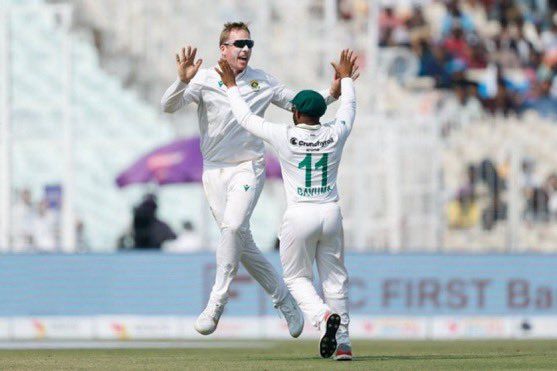
South Africa defy Kolkata and history
For fifteen years South Africa have arrived in India hoping, praying, and usually failing to take a Test match. Kolkata in particular has never been kind to them. Eden Gardens is steeped in memory, drenched in noise, and famous for pitches that slowly close their grip on touring sides. This time, though, South Africa walked…

The King Returns: Quinton de Kock and the Familiar Weight of Greatness
There are cricketers whose careers feel like carefully constructed arcs, plotted with the quiet precision of a novelist. Then there are cricketers like Quinton de Kock – players who burst into the game not as scribes, but as storms. They are less written than remembered. They do not develop so much as arrive. And when…


Leave a Reply