
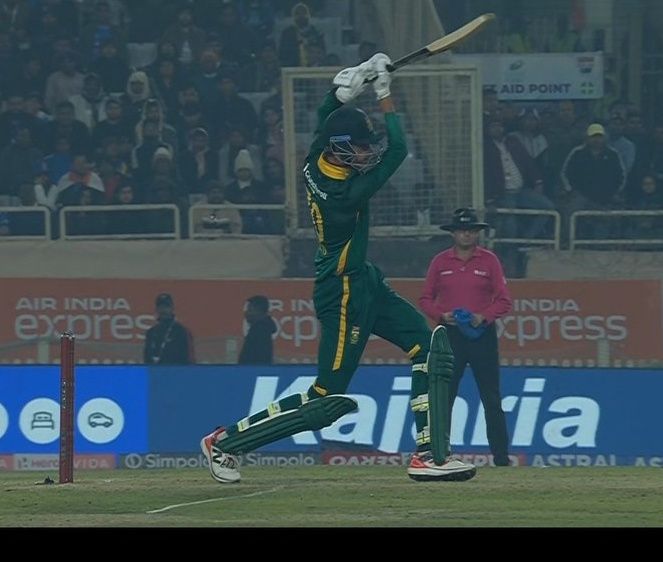
At some point, you stop wondering if the comeback is real and start accepting that it’s built into the bones.
South Africa didn’t win the first ODI against India. They shouldn’t have even been close. At 11 for 3 chasing 350, the script was already written. Another batting collapse. Another tepid away loss. But then something different happened. Not a miracle — just muscle. The kind that’s been slowly forming in the shadows, match by match.
This team isn’t polished. It’s flawed in obvious ways. The top order is brittle — technically proficient, but often overwhelmed by quality new-ball bowling. It’s not a personnel issue so much as a cohesion one. You’ve got four openers jammed into five slots, plus a stand-in opener who’s more of a middle-order rock. It’s no surprise they’ve struggled to soak up pressure when there’s little clarity about role or rhythm.
But underneath that top-order wobble, something dangerous is taking shape: a lower-middle core that doesn’t just survive — it hits back.
Bosch, Jansen, and the Rebuild from the Back
It wasn’t long ago that South Africa’s No. 7 was a long tail-ender and their finishers were late-career improvisations. Now, they have Marco Jansen — who may still look like a gangly kid in warmups but is beginning to carry himself like a man who’s ready to own the final 20 overs of any innings. And Corbin Bosch — still raw, but playing like a man auditioning for something bigger.
Jansen, in particular, has flipped the script. He’s not the kind of guy you label a “finisher” — that’s too limiting. He’s a stretch bowler who can now launch sixes over long-off and then settle into a series of conventional sweeps with the poise of a top-six batter. This version of him — the one we’re seeing now — doesn’t just hang around. He dominates. It’s hard to say he’s taken the next step. But it’s harder to say he hasn’t.
Bosch, too, looks more and more like the kind of cricketer you trust with your World Cup hopes in the last five overs. There’s a bluntness to the way he bats — muscular, confident, and without panic. He’s not there yet. But what matters is that he looks like he could get there. Quickly.
A Team Learning to Live without Dominance
You can win games by being the better team. Or you can win by being the one that refuses to disappear. Right now, South Africa are flirting with the latter. And that may be the more powerful trait in tournament cricket.
This side has already conceded 350+ three times this season — a stat that would’ve triggered existential panic in the old days. But this version of the Proteas doesn’t seem shellshocked by it. They scrap. They counterpunch. They chase totals not with arrogance, but with grit and clarity. They scored 332 without their captain or their finisher. That isn’t a fluke — it’s a sign of depth.
There’s also a confidence in the selection strategy. Shukri Conrad has leaned heavily into the allrounder model, and it’s starting to show its worth. It makes them vulnerable early, sure — but it also gives them time and tools to respond. You don’t often see teams with that much firepower from No. 6 down. When it clicks, it’ll be a nightmare to stop.
Sorting the Top: The Elephant in the XI
But let’s be honest: the top order needs clarity. There’s too much overlap, too little definition. When Temba Bavuma returns, he must open. And Quinton de Kock — if he plays — has to be the other opener. It’s where he’s scored all his ODI centuries. Shoehorning him anywhere else is like buying a Ferrari and never leaving second gear.
That leaves one of Ryan Rickelton or Tony de Zorzi to bat at No. 3. On current form, de Zorzi edges it. Markram should slide to No. 4 — his best spot in the format — and let Breetzke continue to grow into a flexible, counterattacking role at No. 5. It’s a spine that balances anchor, aggression, and flair.
Behind them: de Brevis, Jansen, Bosch. You don’t often get three x-factors in your lower middle. The question now is how to let that structure breathe, instead of smothering it with insecurity up front.
Building Toward 2027 — Quietly, Boldly
This ODI series isn’t about results. It’s about reconnaissance. South Africa’s white-ball structure has looked confused in recent years — this feels like the first time in a while where roles are being tested, not guessed.
They’re not playing perfect cricket — but they’re playing cricket with purpose.
The signs are there: a batting unit that doesn’t rely on its stars, a bowling group still finding its control, and a mentality that doesn’t shatter after 11 for 3. This isn’t the finished product. But it might be the right product.
And if you’re India, Australia, or England watching from afar — you might want to take note. Because something’s stirring.
And this time, it’s not just potential. It’s progress.



Leave a Reply