
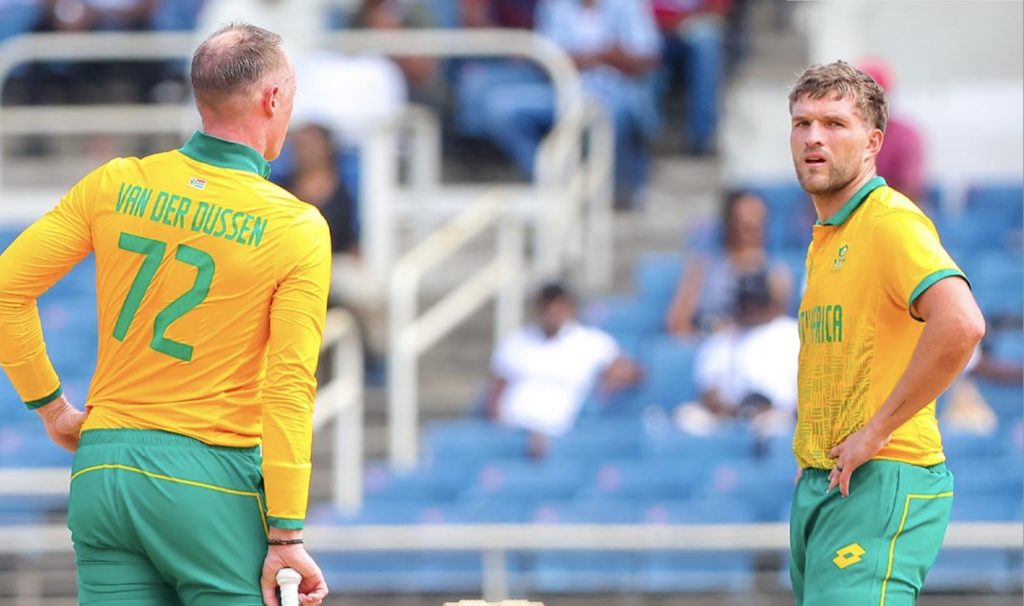
South Africa’s recent 177-run loss to Afghanistan in the second ODI has raised alarm bells. While Afghanistan has emerged as a force in world cricket, a defeat of this magnitude—and the resulting 2-0 series deficit—points to deeper issues within the Proteas’ setup. This isn’t just about one bad day in Sharjah; it reflects a growing concern about the state of South Africa’s cricket pipeline and the performances of their next generation of players.
But to truly understand the gravity of South Africa’s current situation, we need to rewind to January 31, 2016—a date that may have slipped under the radar for many South African cricket fans. On that day, South Africa, the defending champions of the U19 Cricket World Cup, suffered a humiliating defeat to Namibia. That loss was the lowest point in what was a dismal campaign, seeing the Proteas finish 11th overall—below Namibia, Afghanistan, and Nepal. It was an early sign that South Africa’s junior development had hit a serious snag.
A Decline in Junior Cricket Success
From 2008 to 2014, South Africa’s U19 teams were among the most formidable in the world, reaching two finals and one semi-final in four tournaments. That success coincided with the emergence of players born between 1988 and 1995, who formed the foundation of one of South Africa’s more successful white-ball periods. Players from that era played pivotal roles in South Africa’s first knockout win in an ICC World Cup (2015) and their runner-up finish in the 2024 World T20.
However, since 2016, South Africa’s U19 sides had failed to reach the semi-finals of any Junior World Cup until 2024. While junior results don’t always predict senior success, they can be a bellwether for the state of a country’s cricketing pipeline—and South Africa’s pipeline, it seems, is running dry. This underperformance at the junior level has translated into a lack of top-tier talent reaching the senior side.
The “Lost Generation” of South African Cricket
Perhaps the most sobering fact is that South Africa has produced very few reliable international batsmen from the generation born between 1995 and 2000. Tony de Zorzi is the only South African under 30 with an ODI century to his name. Kyle Verreynne is the only player under 30 to have scored a Test century. That’s it. Compare that to past generations, and the talent gap becomes glaringly apparent.
Players once hailed as future stars have fallen short. Wiaan Mulder, touted as the next great South African all-rounder, has struggled to make an impact in any format, averaging less than 20 with the bat and over 40 with the ball in ODIs, while conceding over 9 runs per over in T20s. Tristan Stubbs has shown promise, but his ODI average sits at a lowly 3.67, and he’s yet to establish himself as a consistent performer in Test cricket.
Time to Move On to the Next Generation
With this lost generation unable to step up, it’s time for South Africa to focus on the next crop of talent. One name that has generated considerable hype is Dewald Brevis, affectionately dubbed “Baby AB” after the great AB de Villiers. While Brevis has shown flashes of brilliance, his performances have yet to live up to the lofty expectations. At 21 years old, Brevis is still fighting for a regular spot with the Titans, despite a solid domestic season that saw him score a pair of centuries in both the First-Class competition and the One Day Cup. His all-round abilities—highlighted by a four-wicket haul for SA A—show his potential as a dual threat, but the time is now for him to step up.
Andile Simelane, though raw, is another player who could be fast-tracked into the national setup. A powerful hitter, Simelane’s inclusion could add much-needed firepower to the Proteas’ lineup. Ideally, he would make his debut against Ireland, who pose less of a challenge than Afghanistan’s army of spinners. Young talents like Kwena Maphaka and Lhuan-dre Pretorious also show promise but have yet to feature at the senior level due to school commitments—a reminder of the challenges South Africa faces in balancing education and sport.
Not the First to Struggle Against Afghanistan
It’s worth noting that South Africa is not the first team to struggle against Afghanistan. The Afghan side thrashed New Zealand in the 2024 World T20 and comfortably defeated Australia in the same tournament. They were also one catch away from beating Australia in the 2023 World Cup. Losing to Afghanistan, especially with a second-string side, is not the end of the world. Afghanistan’s spinners, led by Rashid Khan, are a nightmare for any team, and South Africa’s normal middle-order—comprising Heinrich Klaasen and David Miller—is among the best in the world.
However, what makes this series loss concerning is the context. The purpose of these tours is to test South Africa’s depth, and so far, that depth has been found wanting. The Proteas haven’t fielded their first-choice side in any bilateral white-ball series this year and have lost every single one of them. It’s not as though they’ve faced an insurmountable array of opposition. Their losses have come against the West Indies and Afghanistan—two challenging teams, to be sure, but teams that South Africa would expect to compete with, even with a weakened lineup.
Looking Ahead
The current series against Afghanistan has exposed South Africa’s lack of depth and raised questions about the future of their cricketing pipeline. While a defeat to Afghanistan isn’t cause for panic, it’s clear that South Africa must begin investing in the next generation of players. The likes of Brevis, Simelane, Maphaka, and Pretorious need to be fast-tracked into the senior setup, and South Africa needs to move on from the underperforming generation of players who have not delivered on their potential.
International cricket is unforgiving, and South Africa is learning that the hard way. Losses happen—sometimes badly—but how they respond to this series defeat will determine whether the Proteas are heading for a rebuild or a renaissance. With a final ODI against Afghanistan looming and crucial tours on the horizon, the time for South Africa to find answers is now.


Leave a Reply