
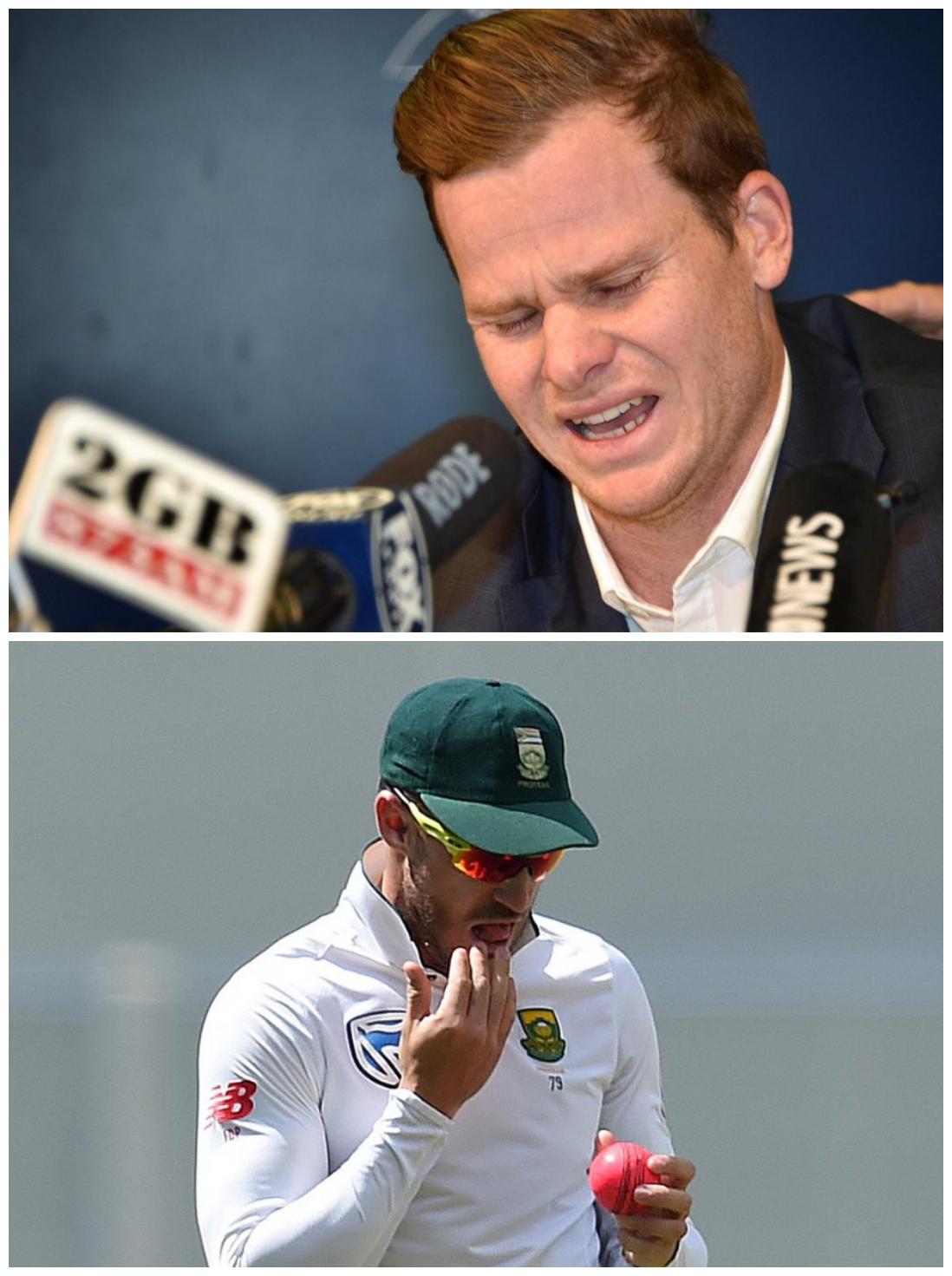
There’s a certain symmetry in the events of the past week or so.
For the uninitiated, today marks exactly ten years since Faf du Plessis, then the South African Test captain, was charged with ball tampering after the Proteas’ second Test victory over Australia in Hobart. The skipper was caught using saliva mixed with residue from a mint in his mouth to keep the shiny side of a cricket ball shinier for longer.
The victory would mark South Africa’s third successive Test series triumph over Australia, and on some level, maybe their most miraculous series win ever, considering they went into enemy territory without AB de Villiers, with Morne Morkel unavailable for the opening Test, and would quickly be without Dale Steyn.
All very well, but unbeknownst to anyone at the time, this series would form the first part of a two-link chain that would fuse these two countries forever in a weird cricketing blood bond over the art of ball tampering.
The second part of the chain, of course, would be the incredible scenes at Newlands Cricket Stadium in March 2018, when Australian opener Cameron Bancroft used a piece of sandpaper to try to accelerate the natural deterioration of one half of a cricket ball.
It’s almost too on the nose: one side nabbed for trying to unnaturally maintain the youthful vigour of one half of a cricket ball, and the other caught trying to accelerate the other half’s ageing process.
In the week since Usman Khawaja reignited one of cricket’s most infamous modern-day controversies with the release of his fabulous autobiography, Sabr, plenty of familiar avenues have been explored.
Who knew what? Who knew what when? Did people know something would be taken to the boundary, but not onto the field?
It’s a bit Jordan Peterson-esque: “When you say, ‘Did I know about sandpaper being used?’ what do you mean by ‘did’? What do you mean by ‘field’? In some sense, the tampering is always happening.”
The less travelled road when discussing all this is, of course: where does South Africa fit in?
In the book, South Africa, both the country and the team acting as its conduit, is a central character.
During a meeting in which the coaching staff reinforces to the team that the modern batsman is too good against the straight ball, and that their only chance is to get the ball moving in the air, Khawaja ends his thoughts on the matter by noting that South Africa were experts at getting the ball to reverse early, sometimes even with a new, hard ball.
When he reports that Australia didn’t tamper with the ball in the first Test in Durban, he recalls the South African team being suspicious about Australia’s actions, while noting that the Aussies were equally suspicious about South Africa’s.
A race to the bottom was loading, it appears, and the thing about winning a race to the bottom is that if you go fast enough, you do tend to crash.
As Khawaja reports in his book, South Africa and Australia, as it pertains to cricket, have something of a love-hate relationship.
For people of a certain age group in both countries, the opposite nation has at times flirted with being the great Beelzebub. But for whatever reason, mostly a shared cricketing calendar that prevents any real regularity, the rivalry never quite made the leap when it was at its hottest in the mid-90s.
As of now, it’s probably just a real test of skill, rather than anything particularly fiery.
Cricket’s changing landscape has made the Border-Gavaskar Trophy an iconic series in its own right. Meanwhile, in South Africa, a changing sports calendar has seen cricket’s position as the sport of the summer slightly more contested than it was a decade ago, let’s say.
An ever-compressing football calendar has seen the domestic football league take up more and more of the summer, while South African rugby’s move from Southern Hemisphere competitions to Europe (a story for another day) has seen the domestic rugby season run through the summer, reducing cricket’s unopposed hold on the country for three good months.
But in March 2018, for one golden month, the rivalry was hotter than it had ever been. And hotter than any rivalry would be allowed to be since its conclusion.
It’s since emerged that Cricket Australia did not take kindly to losing to South Africa at home for a third consecutive series.
It didn’t matter that Australia had won 14 out of 18 Tests at home heading into that 2016 series, with the others drawn. It wasn’t enough.
“We don’t pay you to play, we pay you to win,” Steve Smith recalled Cricket Australia executives James Sutherland and Pat Howard telling the team after the defeat in Hobart.
And they had not beaten South Africa.
On the other side of the coin, South Africa were actually in a crisis, as they tended to be during those days.
Dale Steyn had recovered from the injury that truncated his 2016 series, only to be ruled out of most of this one with another injury. Not ideal.
Kyle Abbott, his deputy in that series in Australia, had left Cricket South Africa to take a Kolpak deal, as politics, both global and cricketing, risked tearing South African cricket apart.
Yet none of that would matter when Australia came to town.
For all the bluster about beating Australia three times on the spin in their own backyard, it had been 48 years since South Africa had won a home series against the Aussies.
And they were hungry for it.
As someone who divides his time between South Africa and Australia, I must confess I didn’t quite understand how big an effect Sandpapergate had on Australian cricket until I moved there.
In South Africa, it was a major story, of course. We’ve all seen the video of Steve Smith being harangued as he tried to catch a flight out of Johannesburg, and the news played large parts of both David Warner’s and Smith’s interviews when they landed in Australia, something not really done.
But it would be a lie to say it was earth-shattering.
By the time Smith and Warner returned for the 2020 series, it was a funny gag, and the bite had long since disappeared.
I can’t quite remember the tweet, and journalistic etiquette would suggest I not share a tweet I can neither recall nor provide, but when Steve Smith said he was getting ready for a hostile return to South Africa during that 2020 series, a member of the Twitterati basically said something to the effect of, “We have serious problems to deal with. We don’t have electricity.”
Which was, firstly, true.
But also a pretty succinct description of where the incident sat between the two nations.
And somehow, six years after that series, it’s still true.
Khawaja’s book saw Sandpapergate revived and discussed around the world again. But in South Africa, the extent of it has been Rabada being asked about it and saying:
“My take is that we’re not concerned about what they have to deal with. It’s not our topic to deal with. It’s obviously an Australian topic. I don’t see where we get involved in that.”
Maybe it’s because South Africa won the series. It’s easier to be a gracious winner, of course.
Maybe it’s because, in South Africa, we find out the president has US$580,000 stashed in a sofa on his farm, supposedly connected to an R8 million buffalo deal involving animals that somehow remain on the property years later, and we write a lot of jokes about it, but ultimately we move on.
Maybe it’s the symmetry of a South African captain avoiding a suspension for ball tampering, while an Australian captain served a one-year ban for his role in a ball-tampering scandal.
Maybe it’s the symmetry of Warner declaring that Australia prided themselves on playing by the rules, insisting “we hold our heads high” and that he would be disappointed if an Australian teammate did what du Plessis had done, before he himself served a ban for his role in a deliberate ball-tampering scheme.
Maybe it’s the symmetry of South Africa complaining about the Australian press hounding du Plessis at the airport, before Smith would experience an even more surreal media circus on his way out of South Africa.
Maybe it’s a sign of the love-hate relationship that Smith and du Plessis each stuck up for the other when they were charged, while du Plessis couldn’t help but stick the boot into Warner, who, it must be remembered, was Smith’s partner in crime!
I think, ultimately, there’s something perversely poetic about the fact that two countries never especially renowned for reverse swing, save the odd proponent here and there, combined to bookend a period in cricket that functionally killed ball tampering and, with it, reverse swing.
First on the shiny side.
And then on the rough.


Leave a Reply